Skip to content
The French Countryside Guide
Menu
  • Home
  • About
  • Administration
  • Culture
  • Travel
    • Auvergne-Rhône-Alpes
    • Bourgogne-Franche-Comté
    • Bretagne
    • Centre-Val de Loire
    • Corse
    • Grand Est
    • Hauts-de-France
    • Île-de-France
    • Normandie
    • Nouvelle-Aquitaine
    • Occitanie
    • Pays de la Loire
    • Provence-Alpes-Côte d’Azur
  • Contact
Menu
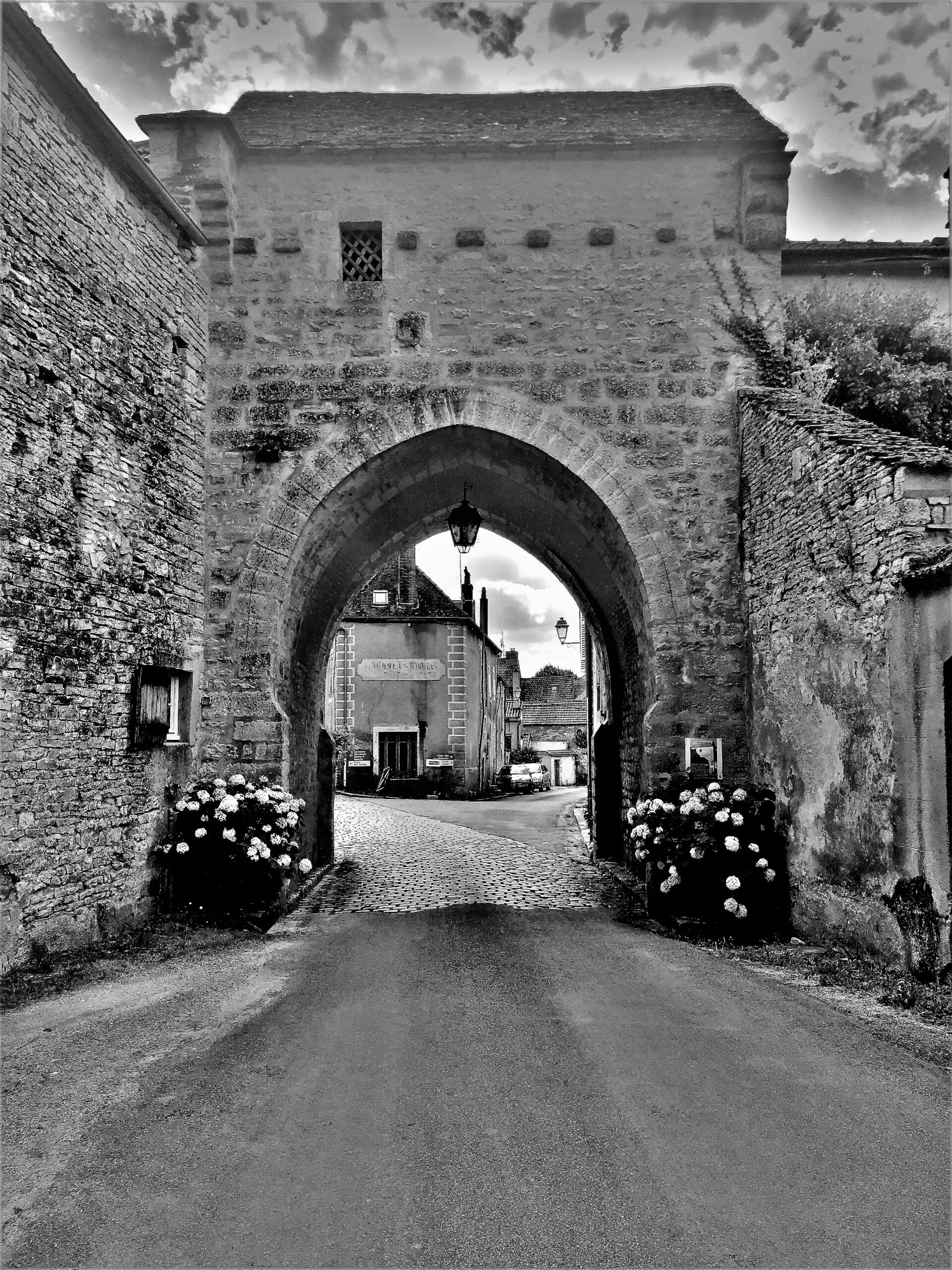
city gateway

Noyers, A Medieval French Village Where History Lies in Every Stone

Posted on June 13, 2021July 28, 2023 by Rose Joly

Noyers, also called Noyers-sur-Serein, is a charmingly small medieval village located in the Burgundian countryside. Classified as one of The Most Beautiful Villages of France, Noyers is sure to transport you back in time!

Ideal for a day walking about or a visit to the local artisans, Noyers is the perfect day trip!

History of Noyers
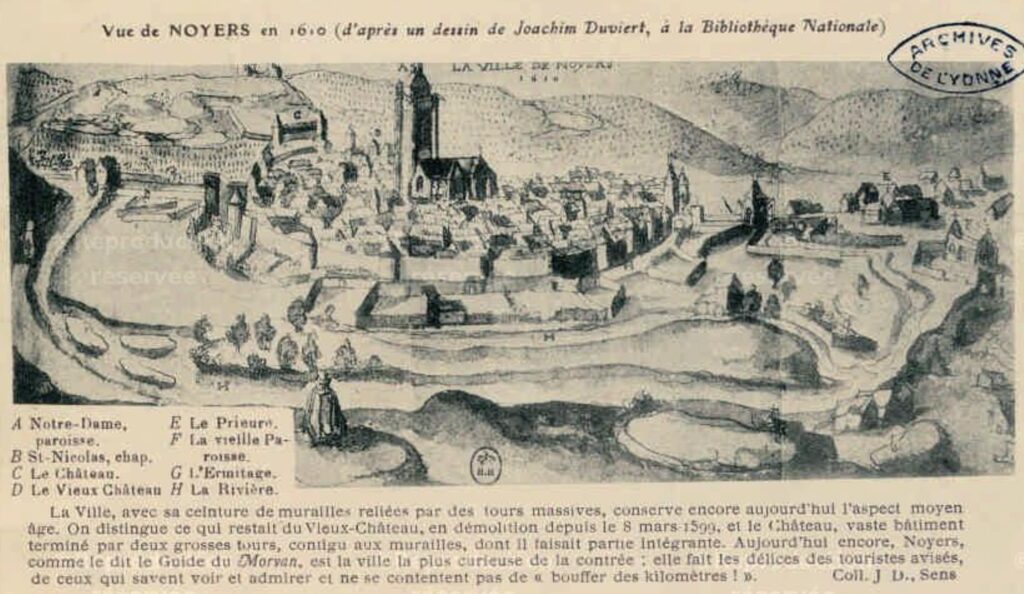
Postcard with drawing of Noyers in 1610 by Joachim Duviert

Origins of the village are not very clear, but are traced back to either founding by the king of the Sequane people or by a contemporary of Julius Caesar named Lucidorius. One thing is sure, though, Noyers gets its name from the “noyer” or walnut trees located in the area!

From the 12th century onwards, the village became the seat of the powerful seigneury of Miles de Noyers. Unfortunately, like all things, the seigneury came to an end. Without any heirs, it was sold to the Duchess of Burgundy in 1419.

After a long period of decline, the city was reborn under the Duke of Luynes who, in 1710, married the last descendant of the Condé family (Dukes of Burgundy).

Horticulture in Noyers

Noyers was once an important merchant village. Wine and grain trades flourished. Many documents note the importance of walnut and cherry trees as well as vineyards located on the surrounding hills.

Even today, farmers still have their place, although artisans and retirees replaced much of the agriculturalists.

Crafts in Noyers

Until the 20th century, local craftspeople included shoemakers, blacksmiths, cartwrights, hoop makers and coopers (for barrels). Nowadays, artisans in Noyers comprise of painters, potters, carpetmakers, leather crafters, and even a manuscript illuminator!

Why Should You Visit?

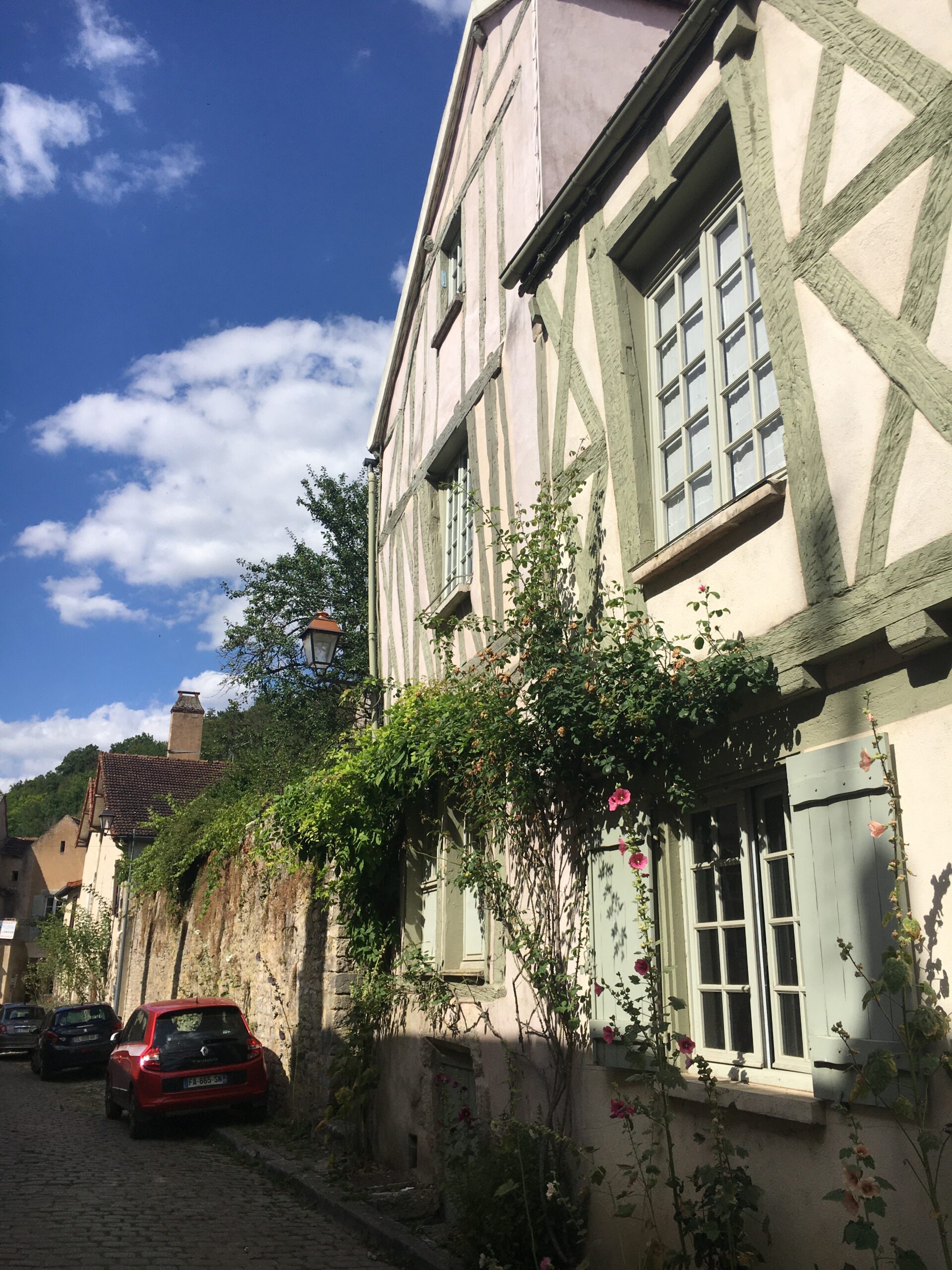
Noyers offers the rare picture of a preserved medieval village. With nearly 80 listed buildings dating from the 15th to the 19th centuries, many are remarkable 15th and 16th century half-timbered houses. One such house is the “maison du compagnonnage” (house of companionship) with its sculpted capitals dating to the 15th century. Representing Saint Crépin patron of the shoemakers or Saint Crépinien patron of the bakers, these sculptures are so small and cute!

Maison de la Toison d’Or (House of the Golden Fleece)
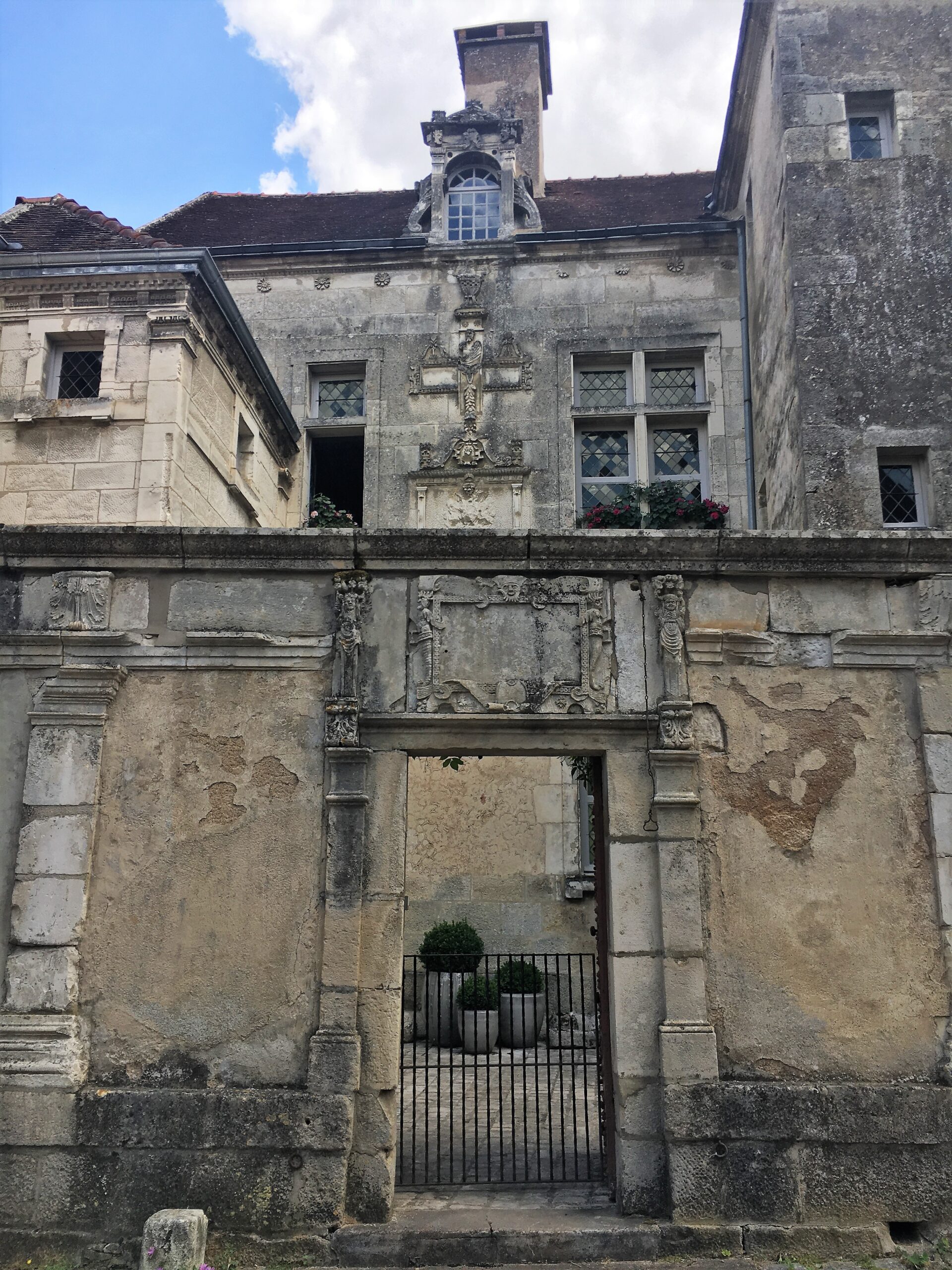
This is one of the first houses that caught my eye upon entering Noyers. It is a gorgeous noble house from the 15th century by Philippe Pot, minister of Philippe le Bon, Duke of Burgundy. Apparently, the Duke created the Order of the Golden Fleece and stayed in the home in 1433, possibly lending to its name. The façade visible today is of a Renaissance style with absolutely fascinating stone carvings.

Le Kamato

Another gem of 15th century architecture is the Kamato. Translating to “by suffering” from Greek, this was the house of justice and residence of the lordly bailiff. According to tradition, it would have housed pilgrims on their way to Santiago de Compostela.

Hôtel-Dieu Saint-Nicolas (Poorhouse of Saint-Nicolas)

Whilst walking around the village, I saw this particular building, the ancient hospice of Saint Nicholas. Founded in 1650 by Pierre de Selles, lord of Clavisy and resident priest at Noyers, this large building is now a hotel.

While returning home from hosting mass in a nearby village whose inhabitants could not come to Noyers due to flooding, de Selles nearly died when he fell under his horse in the overflowing river. Attributing his survival to the grace of God, de Selles decided to found the Hôtel-Dieu (poorhouse) of Saint Nicolas. Along with paying for its construction, de Selles also offered an annuity of 385 livres used to feed 6 poor persons as well as the person in charge of their care. Unfortunately, by 1750 the buildings had deteriorated to such an extent that they were almost uninhabitable.

After nearly 30 years of dispute, disuse and deterioration, the hospital of the faubourg joined the Hôtel-Dieu on December 20, 1782. This civil hospice thus functioned for 80 years.

By 1855, the Hôtel-Dieu closed its doors. Four years later, a Parisian notary purchased it. As before, the buildings eventually fell into ruin to be sold and renovated. The building now houses a hotel open to this day.

L’Ancien Collège (The Former College)

Founded in 1633 by the Christian Doctrine Fathers, this building has a striking sundial decorating its side. Accompanying it, a motto written in Latin evokes the passage of time.

Quis melior vitae monitor rerumque Magister Cum doceat rapido quo fugit hora pede itque redit que viam constans quam suspicis umbra Umbra fugax hommines non reditura susmus 

The text translates to: “What better guide of our life that teaches us better the things of here below than the hour by the only fast step of which it flees. You have only one to fear: It comes and goes along your way, the shadow you dread. We are only a fleeting shadow that will not return.”

Les Tours et Remparts (The Towers and Ramparts)

The fortifications surrounding the city date back to the 13th century. Surprisingly, 19 of its 23 original towers are still visible or intact to this day.

You can book a guided tour of the fortified enclosure, weapons room and collection of armor, all to be led by a costumed guide.

If that is not your thing, I suggest walking the whole way around the ramparts for a picturesque and leisurely stroll where you can peep all 19 of the towers.

La Porte de Tonnerre

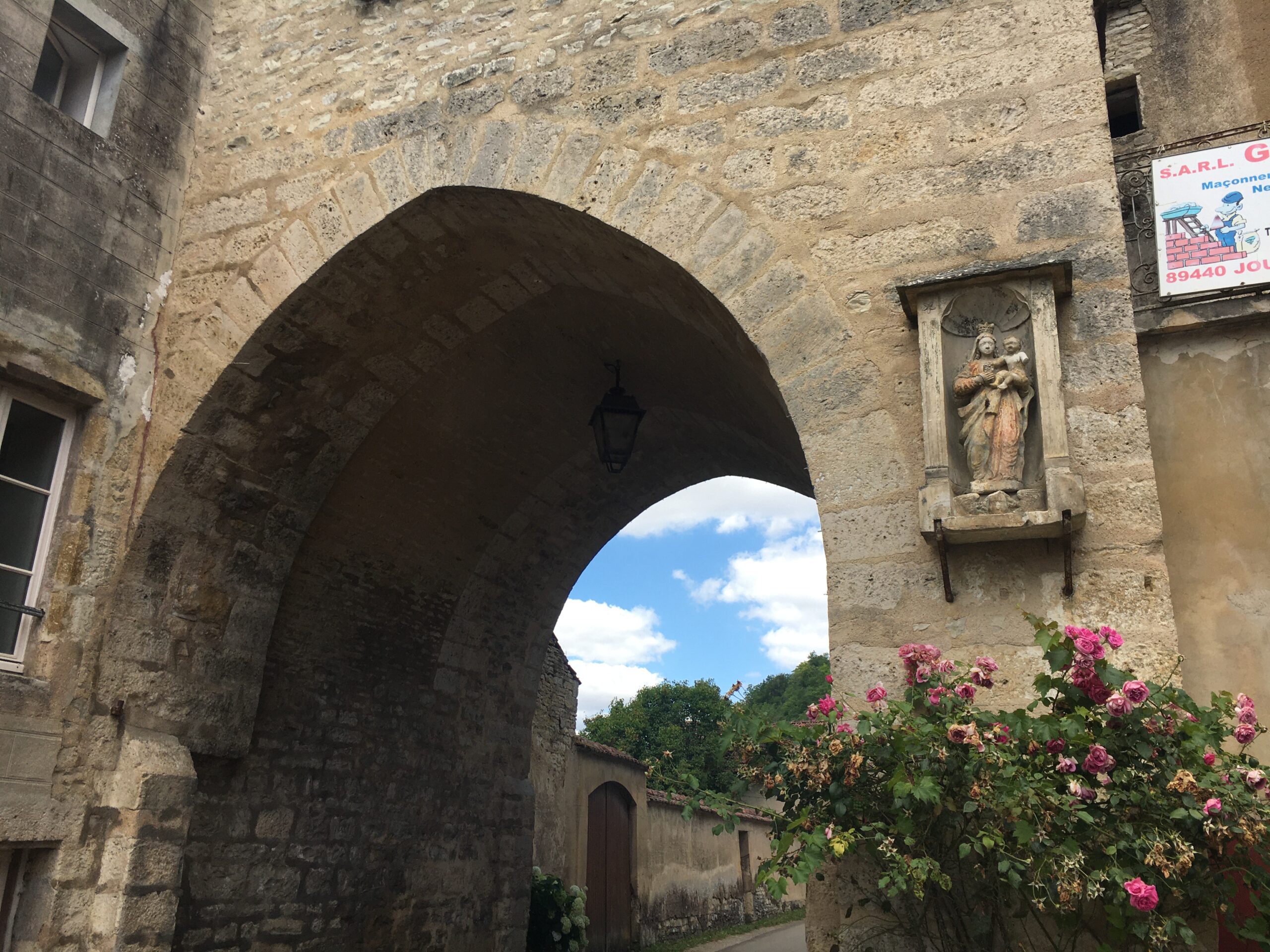
Part of the ramparts, the “Porte de Tonnerre” (thunder gate) is a gorgeous vestige of yesteryear. An important toll gate protected by multiple canons, this entry into the village also hides an interesting tradition.

Located in a niche facing the village is a 15th century polychrome statue of Notre Dame de la Voie de Passy (Our Lady of the Path of Passy). Nicknamed Sainte Vérote, she is decorated with vines of green grapes (called vérots) every 15th August. This tradition protects the grape vines from summer storms.
Vieux Château (Old Castle)

Another piece of history you can visit that is located just a bit outside of the village walls are the old castle ruins. Clerembaud de Noyers began its construction in 1190 before departing in crusade. Unfinished, the castle’s primitive foundations underwent a radical transformation by Hugues de Noyers at the end of the 12th century. As well, he also built the ramparts surrounding the village.

Museums

If you are not so much into looking at the architecture, you can always visit one of Noyer’s many museums.

Le Musée des Arts Naïfs et Populaires de Noyers is the number one museum in the department focusing on naïve and popular arts. The Maison du Schematisme is a fascinating museum dedicated to the avant-garde art movement of the 1960s of the same name.

La Serpentine

A nature walk amongst the ruins of the old château? You betcha! Guided by George, the guardian of Saint-Georges Mountain, you will discover the history of the old château. Composed of 12 informational panels, this historic walk takes about an hour to complete.

How English Friendly is it?

As I always say, you don’t need to speak French to appreciate art and architecture, your surroundings will speak for themselves! However, if you are looking for an English-friendly visit, this is somewhat a good choice.

Although the website and, it appears, most of their information booklets, plaques are for the most part in French, you can take a guided tour of the village in English. For this, you must call in advance to request one. Tours generally last 1.5 to 2 hours and prices are listed at 6.50€ per person.
Call at : 03 86 82 66 06

Unfortunately, I cannot speak about the quality of the guided tour, neither in French or English. When we showed up at the tourist office, although the website stated tours were held on that day, the kind woman told us that was not the case. Therefore, we went about touring the village ourselves.

Tips and Other Events

My tip is to call in advance if you want to take a guided tour. Also, make a stop at the tourism office for a free guidebook!

Le Gargouillosium

If you like gargoyles and stone carving, take a trip to Noyers during the 3-day event called “Le Gargouillosium”. During this period, 20 stone carvers unite at the site of the old château in order to amaze spectators and raise profits for charity.

All works are sold to profit the stonemasons as well as the charitable organization, Le Patrimoine Oublié – Association du Vieux Château de Noyers, which focuses on the restoration of the château.

Check the agenda for their next event.

Stone Carving Course

You can get your hands dirty as well! Think about signing up for a half-day’s introduction to stone cutting or decorative stone carving. The cost is 30€ per person (which is actually quite reasonable!)

If you choose to do the stone cutting course, the facing stones that you make will be used in the restoration of parts of the château. How cool!

For reservations, please call/email: 09 80 91 98 48 or contact@lepatrimoineoublie.fr

La Fête du Château

Taking place in August, this celebration honoring the château is a don’t-miss opportunity. A concert, lots of food and other surprises await you, just don’t forget to sign up!

Le Marché de la Truffe de Bourgogne (Burgundian Truffle Market)

The Sunday following Halloween (aka Toussaint) and the last Sunday of November are the days to come to Noyers if you are interested in truffles. Not just any truffles, these “black diamonds” are cultivated in Burgundy and attract quite a crowd! Information about the market is found here.

For other information, contact the Tourism Office of Noyers.

Read More:

  • Guédelon, A Rare Glimpse into the Building of a Medieval Châteauphotograph of modern construction of a medieval castle in france
  • Sens & Villenueve-sur-Yonne, A Day Out Exploring in Bourgogne
  • The Shockingly Dark History of the Abbey of ClairvauxClairvaux prison with retaining bars and door

Share this:

  • Share on Pinterest (Opens in new window) Pinterest
  • Share on Facebook (Opens in new window) Facebook
  • More
  • Share on Reddit (Opens in new window) Reddit
  • Email a link to a friend (Opens in new window) Email
  • Share on X (Opens in new window) X

Leave a ReplyCancel reply

This site uses Akismet to reduce spam. Learn how your comment data is processed.


Salut! I’m Rose.
I’m an American married to a Frenchman living in the countryside of France. I’m here to fill you in on life here, from administrative paperwork to weird customs to underrated places to visit.

Support This Blog

When I took this photo, I was more focused on the When I took this photo, I was more focused on the cute alleyway and the passage between the buildings. 

I had no idea that I was actually photographing another one of the three remaining medieval gateways into the village of Conques. 

Known as the Porte de Fer (Iron Gate), this fortified gateway allowed access to gardens and meadows located in the Ouche valley. 

#Conques #Fortifications #medievalarchitecture #medieval #France
Imagine my surprise when I walked into the Treasur Imagine my surprise when I walked into the Treasury of the Abbey of Sainte-Foy in Conques to find this stained glass on display. 
I’m a huge nerd for stained glass & these works are particularly interesting.
Swipe for the history of these bays. 👉🏻 

📷 La Translation des Reliques de Sainte Foy. Francis Chigot & Pierre Parot (illustration).
The transfer of the relics of Saint Faith. 

#FrancisChigot #stainedglass #abbatialesaintefoy #Conques #FrenchHistory

Created by French stained-glass artist Francis Chigot of Limoges (1879-1960) for the Monuments Historiques in 1940 (yes, during the war!), these windows once adorned the Abbatiale of Sainte-Foy of Conques. 

Pierre Parot, one of Chigot’s trusted illustrators, designed the 104 windows which would take over a decade to be created.

Of the windows I have seen, colors seem to concentrate around jewel-tones as well as a range of oranges which must have been really complimentary to the architecture of the abbey, especially the orange toned stained glass against the red sandstone and yellowish limestone of its construction. 

If you’ve visited or seen photos of Conques, you are aware that the stained glass adorning its bays is nothing like those created by Chigot. 👉🏻

📷 La Translation des Reliques de Sainte Foy. 
Francis Chigot & Pierre Parot (illustration).
The transfer of the relics of Saint Faith.

#Stainedglass #1940s #vitrail #FrancisChigot #frenchhistory 

Unfortunately, Chigot’s work was deinstalled from 1990 to 1992 as part of a project to replace all windows beginning in 1987.

The colorful glass, many of which was narrative, was replaced in 1994 with (in my opinion) dull and unimaginative stained glass designed by Pierre Soulages, an artist local to the region. 

On the bright side, many of the Chigot windows have been preserved & are now permanently integrated into architecture or are on display in different areas around the region. Not only does this keep them in good condition, we are still able to admire their beauty and details (up close!) nearly 80 years after their creation… such as these little faces painted in a very typical 1940s/50s fashion!

#FrancisChigot #Vitraux #Stainedglass #Closeup #F
All the ancient archways. Located at the foot of All the ancient archways. 

Located at the foot of the village of Conques, the Port du Barry (the Barry gate), is one of three remaining fortified portals of the town’s city walls dating to around the 13th century.

#Conques #medievalarchitecture #France #Aveyron #travelinfrance 

📸 “CONQUES - Ancien porte fortifiée du BARRY.” Unknown, c. 1907.

#Conques #MedievalFrance #France #oldphoto #occitania
Penne (Tarn) is such a wonderful medieval village Penne (Tarn) is such a wonderful medieval village without all of the tourists. 

Plus, they have a 12th century fortified castle constructed on a cliffside that they are slowly rebuilding proper medieval style, brick by brick, by hand. 

#Penne #occitanie #medievalarchitecture #France #medievalfrance
Two views. One beautiful place. Le Pont Vieux, C Two views. One beautiful place. 

Le Pont Vieux, Camarès. 
A beautiful stone bridge dating back to the 11th century crossing over the Dourdou. 
Interestingly, the name “Camarès” once referred to the region, while the town itself was known as Pont-de-Camarès, deriving the name from the Pont Vieux (the old bridge) which was one of the only means of crossing the river.

#Occitanie #France #Camarès #frenchhistory #historicalplaces 

Two views. One beautiful place. 

Le Pont Neuf, Camarès. 
The Pont Neuf (new bridge), built in 1856, was the consequence of an Industrial Revolution taking place in Camarès. As early as the 17th century, textile mills dotted the banks of the Dourdou, first reputed for their woolen blankets, then their knitwear.

What I find most interesting is that this past, although I had no previous knowledge of the town’s history whilst visiting, was so evidently clear in the architecture left behind from the 19th century. 
Plus the views are breathtaking. 

#Occitanie #France #Camarès #frenchhistory #historicalplaces 

Olivet, “Camarès (Aveyron) - Le Pont Vieux et le Quartier de L’Eglise.” No date.

#Occitanie #France #Camarès #frenchhistory #historicalplaces 

Unknown, “Camarès - Le Pont Neuf, 22 August 1929”

#Occitanie #France #Camarès #frenchhistory #historicalplaces
Just a little archway to adventure. #penne #penn Just a little archway to adventure. 

#penne #pennetarn #tarn #france #francetravel
Beautiful frosted glass contrasts with the golden Beautiful frosted glass contrasts with the golden tones of silver stained curves. Stained-glass designed by Fabienne Verdier in 2018.

 #church #architecture #history #frenchblog #travelinfrance #travel #expatinfrance #France #hiddengems #frenchcountrysideguide #frencharchitecture #frenchchurch #eglise #tourisminfrance #stainedglass #frenchstainedglass #vitrail #vitraux #fabienneverdier #champagnetourisme #aube #aubetourisme #routeduvitrail #nogentsurseine #travelblog #expatblog #Francetravel
Constructed on the site of a former salt storehous Constructed on the site of a former salt storehouse in 1670, the greniers à sel (salt storehouses) are a beautiful reminder of Honfleur’s maritime history. 

Originally a trio of stores, only two are extant; the later of the stores, built in 1699, burnt down in 1892.

Designed to store the salt necessary for fishing (herring and cod), they were one of the largest open salt stores in Normandy. It is likely that the stones creating its walls are the remnants of the city’s old fortifications. 

Sold as national property during the French Revolution in 1791, it was not until 1806 that the state transferred ownership of the large salt storehouse (at 500m2) to the town of Honfleur. At this time, it was used as a butcher’s shop and then reinstated as a salt storehouse up until 1908 where it was later sold. The town repurchased the store in 1949.

As for the small salt store (at 381m2), it remained private property until 1952, when it was purchased by the town of Honfleur. 

Both of the storehouses were classified as historic monuments in 1916.

Pictured is the exterior pathway between both of the storehouses that connects them together.

 #MonumentHistorique #architecture #blog #historicalmonument #history #frenchblog #historicalplace #expatlife #travelinfrance #travel #cultureblogger #americaninfrance #lifeinfrance #frenchcountrysideguide #frenchpatrimony #frenchhistory #france #Frencharchitecture #Francetravel #travelblog #Honfleur #Normandy #Normandie #greniersàsel #greniersàseldhonfleur #stonework #masonry  #expatinfrance  #expatblog #travelblog
Stained glass designed by Maurice Rocher (dating t Stained glass designed by Maurice Rocher (dating to 1973) located in the Chapelle de l'Immaculée at the Basilique Sainte-Anne d'Auray in Morbihan, Bretagne.

#bretagne #brittanyfrance #breizh #brittany #BZH #Morbihan #baiedequiberon #sainteannedauray #auray #travelblog #vitraux #stainedglass #Francetravel #expatblog #France #Frencharchitecture #frenchcountrysideguide #frenchpatrimony #travel #travelinFrance #cultureblogger #historicalplace #architecture #monumenthistorique #historicalmonument #church
Follow for Updates

Recent Posts

  • Renewing an Adult 10-Year U.S. Passport in France by Mail
  • I Went to a Traditional French Catholic Wedding!
  • The OFII In France and the Integration Process: La Formation Civique
  • Sens & Villenueve-sur-Yonne, A Day Out Exploring in Bourgogne
  • “Chandeleur,” The Day of Crêpes… and Candles?

Archives

  • June 2025
  • August 2023
  • July 2023
  • March 2023
  • February 2023
  • January 2023
  • January 2022
  • August 2021
  • June 2021
  • May 2021
  • April 2021
  • March 2021
  • December 2020
  • November 2020
  • October 2020
Banner supporting blood donation

Legal

  • About
  • Contact
  • Cookie Policy
  • Intellectual Property
  • Privacy Policy

Search

© 2026 The French Countryside Guide | Powered by Minimalist Blog WordPress Theme