Skip to content
The French Countryside Guide
Menu
  • Home
  • About
  • Administration
  • Culture
  • Travel
    • Auvergne-Rhône-Alpes
    • Bourgogne-Franche-Comté
    • Bretagne
    • Centre-Val de Loire
    • Corse
    • Grand Est
    • Hauts-de-France
    • Île-de-France
    • Normandie
    • Nouvelle-Aquitaine
    • Occitanie
    • Pays de la Loire
    • Provence-Alpes-Côte d’Azur
  • Contact
Menu

“Chandeleur,” The Day of Crêpes… and Candles?

Posted on February 2, 2023February 2, 2023 by Rose Joly

Like every day, February 2nd is another day to celebrate France’s delicious gastronomy.
Unlike every day, crêpes dominate the day.

When I first moved here and encountered free (yes, free) crêpes being handed out this day, I asked my husband “is it like national donut day, but crêpes because we are in France?” Sorry to be the bearer of bad news, but it turns out that National Crêpe Day does not exist here. What does exist, instead, is a (Christian) holiday with deep-rooted traditions that so happens to translate to free crêpes…

February 2: The Day of Three Feasts

This holiday is actually a celebration of three different celebrations: the Feast of the Presentation, Relevailles AND Chandeleur.

The Presentation & Relevailles

The Feast of the Presentation marks the presentation of the baby Jesus in the Temple of Jerusalem. This takes place 40 days after his birth (aka February 2). Why 40 days? In this period, women, after having given birth, were “impure” and unable to approach the Temple or holy things. To ensure her return to the Temple as a chaste woman, she was purified of her blood. Such a purification process took 40 days for those birthing a son and 80 for those birthing a daughter.
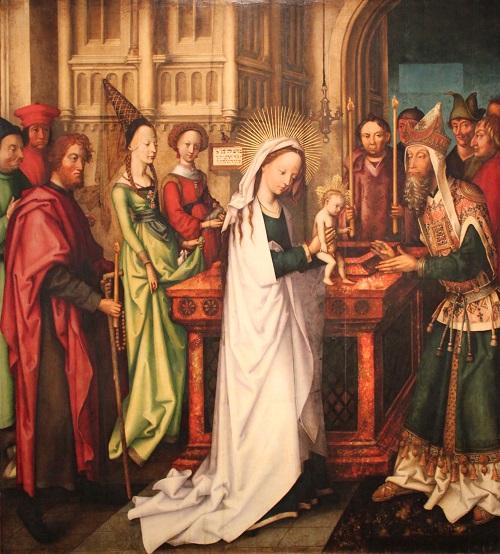
Presentation of Jesus in the Temple

Following this period was the ceremony of “Relevailles” as it is called in French. This ceremony has the purpose of purifying the “unclean” women as to reintegrate them into the church. Women came to the Temple with an offering: “a lamb of the first year for the burnt offering and a dove or a turtle-dove for the sacrifice of atonement” (if she was poor, she could offer two doves or two pigeons).
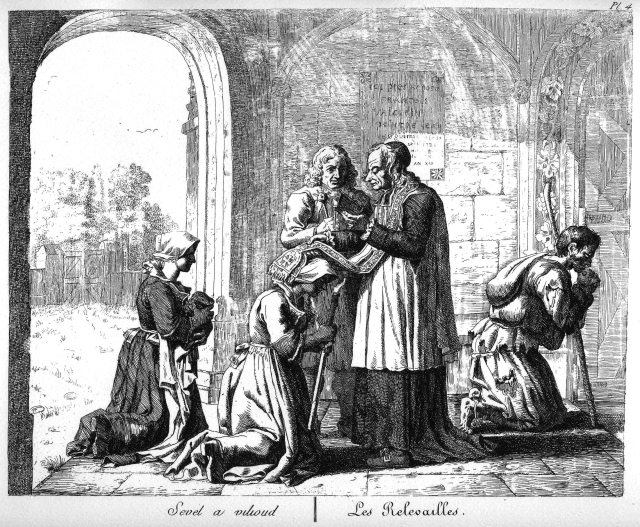
Engraving of Relevailles in Bretagne, 1808

It is due to the presentation of Jesus at the Temple as well as these purity rituals that many now associate Chandeleur with the Virgin Mary.

Putting the “Chandelle” in “Chandeleur”

The word “Chandeleur,” also known as Candlemas in English, comes from the Latin “festa candelarum,” or the “feast of candles.”

It seems that Pope Gelasius introduced this “festa candelarum” to Rome in the late 5th century C.E. This feast consisted of blessing the candles followed by a candlelight procession. Such processions celebrated “Jesus [the] light of Israel”.

In modern times, the Church blesses the candles and keeps them alight as a sign of purity and to ward off evil. Some worshippers even take home a candle to display in their window; tradition obliges that all candles in the house are to stay lit on this day.

In French, a “chandelle” is defined as a long candle. As you may notice, “chandelle” and “chandeleur” sound a whole lot like the word “chandelier.” Ironically, in French, a “chandelier” is a candlestick holder, so don’t go talking about people’s hanging light fixtures using that word. (P.S. a hanging light fixture is a “lustre”)

Crêpes, Customs & Superstitions

Another tradition attributed to Pope Gelasius is the consumption of crêpes, who is credited with distributing them to pilgrims arriving in Rome.

Others view the consumption of crêpes as a vestige of Celtic and pagan traditions. The Vestal Virgins, for instance, at the time of the Lupercalia offered cakes made with the wheat of the old harvest so that the next one would be fruitful as well. In Celtic tradition, the round shape and golden color of the crêpe represented the solar disk and the return to the light. Consumption of the crêpe was symbolic of the cycle of seasons and references the arrival of spring.

Supersitions

“The Hypothesis of the Bear”

Speaking of the arrival of spring…

Have you ever heard of “l’hypothèse de l’ours”? or the “hypothesis of the bear”?

So it turns out that in France, they have their own version of Groundhog Day. This concerns a really old popular saying that the bear comes out of hibernation at Chandeleur. Essentially, if the weather is nice and the bear sees his shadow, winter will be extended by 40 days. However, if he does not see his shadow and the weather is awful, we are in the clear. Whew!

“Le jour de la Chandeleur, l’ours rit ou pleure”

“On Candlemas day, the bear laughs or cries”

Unfortunately, I haven’t seen any bears around where we live. It is unclear how or when the verdict will be reached. Does the absence of a bear in of itself automatically mean extension of winter? If a tree falls in the forest and no one is around… Just kidding! We can also count on the weather to predict whether or not it will be longer, just read this:

“Le soleil de la chandeleur annonce hiver et malheur”


“The Candlemas sun announces winter and misfortune”
The Lucky Flip

Superstition would have it that if the peasants did not make crêpes during Chandeleur, the wheat harvest would be bad the following year. In order to ensure the prosperity of the harvest, they followed a tradition dating to the end of the 5th century C.E. The tradition states that the crêpe had to be flipped in the air using the right hand while a gold coin was held in the left; if the crêpe fell perfectly back into the pan, it was placed on top of a cupboard. There, it would stay to keep away misery and destitution as well as to bring an abundant harvest.

I imagine it collected dust until the next year came… or some rodents looking for food!

History of the Crêpe

Crêpes have a very similar history to that of the galette Bretonne (the savory buckwheat crêpe).

Whereas the buckwheat crêpe made its appearance in Bretagne around the 13th century, historians have established the origin of the basic crêpe around 7000 B.C.E. Appearing around the same time as porridges and unleavened bread, this crêpe was extremely rudimentary. In fact, it was a simple paste of crushed cereals and water dried out and cooked in the hearth of the fireplace.

Beginnings of the Crêpe

In France, we find the first trace of a recipe for “crespes” in the book Le Ménagier de Paris of 1393. Consisting of wheat flour, eggs, water, salt and wine, this dough was cooked in a mixture of lard and butter. Landowners and the well-off had the luxury of wheat “crespes” while the majority of the countryside folk consumed “crespes” made with buckwheat flour. Crêpes soon replaced bread, becoming a staple in the Breton countryside diet.
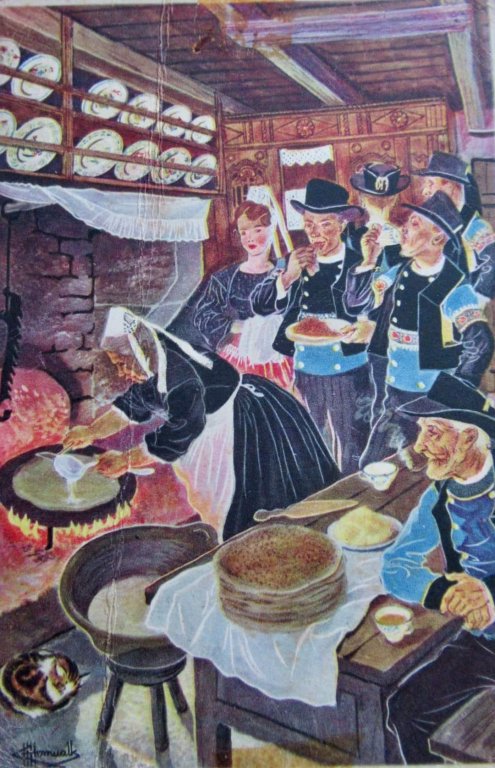
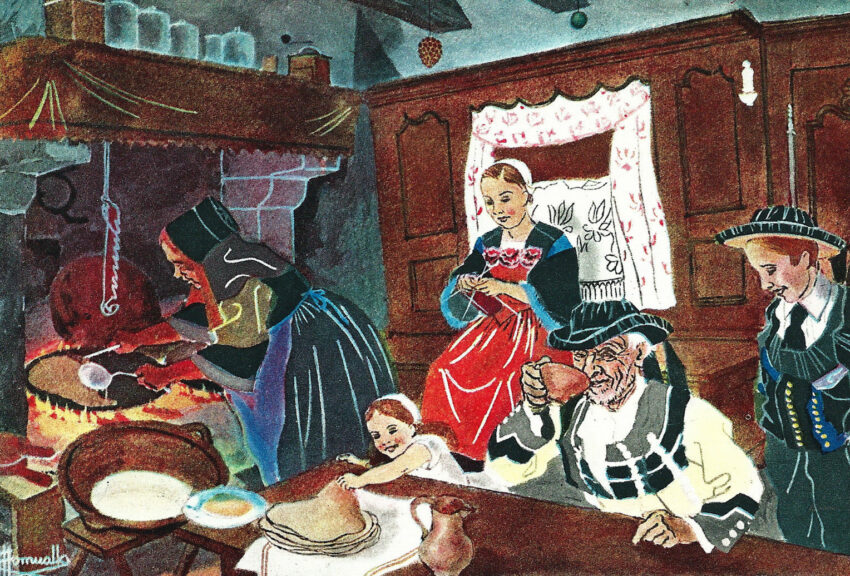
Bretons making crêpes using the pillig

In the 15th century, the first “pillig” (or galétoire) made their appearance, along with the first appearance of the job of crêpier/crêpière. Made of cast iron, this metal pan could be up to 70cm (over 2ft) in diameter, providing a better worksurface. When in use, the pillig was placed on a tripod in the hearth of the fireplace and heated by small branches skillfully arranged. Cooked one by one and consumed by hand, the crêpe was a filling, fast, and inexpensive dish. It was a full meal at this time, and many delighted in serving it with salted butter, churned milk, and potatoes multiple times a week.

In fact, such a process became so popular that these crêpiers/crêpières (crêpe cooks) hired themselves out for parties and weddings!

The Sweet Crêpe

We owe the sweet crêpe to these cooks who, making crêpes as dessert for these parties, mixed one or two eggs into the dough and flavored it with cinnamon and orange blossom. Today, we make sweet crêpes using milk, eggs, wheat flour, sugar and rum; however, buckwheat still predominated the market at this time. By the 18th century, the Universal Dictionary described the crêpe as a type of pastry.


Pastry or other, the crêpe is certainly a delight and staple of French cuisine… as well as my weekend brunch routine!

Hope you enjoyed the read,

Bisous,
Rose


Read More:

  • When Someone Says “France:” The Most Popular Stereotypes About France DebunkedImages of French cliches such as the Eiffel Tower, croissants, and cheese
  • I Went to a Traditional French Catholic Wedding!Bride at altar
  • Getting Married in France (Twice!)

Share this:

  • Share on Pinterest (Opens in new window) Pinterest
  • Share on Facebook (Opens in new window) Facebook
  • More
  • Share on Reddit (Opens in new window) Reddit
  • Email a link to a friend (Opens in new window) Email
  • Share on X (Opens in new window) X

Leave a ReplyCancel reply

This site uses Akismet to reduce spam. Learn how your comment data is processed.


Salut! I’m Rose.
I’m an American married to a Frenchman living in the countryside of France. I’m here to fill you in on life here, from administrative paperwork to weird customs to underrated places to visit.

Support This Blog

Imagine my surprise when I walked into the Treasur Imagine my surprise when I walked into the Treasury of the Abbey of Sainte-Foy in Conques to find this stained glass on display. 

I’m a huge nerd for stained glass & these works are particularly interesting.

Swipe for the history of these bays. 👉🏻 

📷 La Translation des Reliques de Sainte Foy. Francis Chigot & Pierre Parot (illustration).
The transfer of the relics of Saint Faith. 

#FrancisChigot #stainedglass #abbatialesaintefoy #Conques #FrenchHistory 

Created by stained-glass artist Francis Chigot of Limoges (1879-1960) for the Monuments Historiques in 1940 (yes, during the war!), these windows once adorned the Abbatiale of Sainte-Foy of Conques. 

Pierre Parot, one of Chigot’s trusted illustrators, designed the 104 windows which would take over a decade to be created.

Of the windows I have seen, colors seem to concentrate around jewel-tones as well as a range of oranges which must have been really complimentary to the architecture of the abbey, especially the orange toned stained glass against the red sandstone and yellowish limestone of its construction. 

If you’ve visited or seen photos of Conques, you are aware that the stained glass adorning its bays is nothing like those created by Chigot. 👉🏻

📷 La Translation des Reliques de Sainte Foy. 
Francis Chigot & Pierre Parot (illustration).
The transfer of the relics of Saint Faith.

#FrancisChigot #stainedglass #abbatialesaintefoy #Conques #FrenchHistory 

Unfortunately, Chigot’s work was deinstalled from 1990 to 1992 as part of a project to replace all windows beginning in 1987.

The colorful glass, many of which was narrative, was replaced in 1994 with (in my opinion) dull and unimaginative stained glass designed by Pierre Soulages, an artist local to the region. 

On the bright side, many of the Chigot windows have been preserved & are now permanently integrated into architecture or are on display in different areas around the region. Not only does this keep them in good condition, we are still able to admire their beauty and details (up close!) nearly 80 years after their creation… such as these little faces painted in a very typical 1940s/50s fashion!

#FrancisChigot #stainedglass #abbatiale
Penne is such a wonderful medieval village without Penne is such a wonderful medieval village without all of the tourists. 
Plus, they have a 12th century fortified castle constructed on a cliffside that they are slowly rebuilding proper medieval style, brick by brick, by hand. 

#Penne #occitanie #medievalarchitecture #France #medievalfrance
Penne (Tarn) is such a wonderful medieval village Penne (Tarn) is such a wonderful medieval village without all of the tourists. 

Plus, they have a 12th century fortified castle constructed on a cliffside that they are slowly rebuilding proper medieval style, brick by brick, by hand. 

#Penne #occitanie #medievalarchitecture #France #medievalfrance
Two views. One beautiful place. Le Pont Vieux, C Two views. One beautiful place. 

Le Pont Vieux, Camarès. 
A beautiful stone bridge dating back to the 11th century crossing over the Dourdou. 
Interestingly, the name “Camarès” once referred to the region, while the town itself was known as Pont-de-Camarès, deriving the name from the Pont Vieux (the old bridge) which was one of the only means of crossing the river.

#Occitanie #France #Camarès #frenchhistory #historicalplaces 

Two views. One beautiful place. 

Le Pont Neuf, Camarès. 
The Pont Neuf (new bridge), built in 1856, was the consequence of an Industrial Revolution taking place in Camarès. As early as the 17th century, textile mills dotted the banks of the Dourdou, first reputed for their woolen blankets, then their knitwear.

What I find most interesting is that this past, although I had no previous knowledge of the town’s history whilst visiting, was so evidently clear in the architecture left behind from the 19th century. 
Plus the views are breathtaking. 

#Occitanie #France #Camarès #frenchhistory #historicalplaces 

Olivet, “Camarès (Aveyron) - Le Pont Vieux et le Quartier de L’Eglise.” No date.

#Occitanie #France #Camarès #frenchhistory #historicalplaces 

Unknown, “Camarès - Le Pont Neuf, 22 August 1929”

#Occitanie #France #Camarès #frenchhistory #historicalplaces
Just a little archway to adventure. #penne #penn Just a little archway to adventure. 

#penne #pennetarn #tarn #france #francetravel
Beautiful frosted glass contrasts with the golden Beautiful frosted glass contrasts with the golden tones of silver stained curves. Stained-glass designed by Fabienne Verdier in 2018.

 #church #architecture #history #frenchblog #travelinfrance #travel #expatinfrance #France #hiddengems #frenchcountrysideguide #frencharchitecture #frenchchurch #eglise #tourisminfrance #stainedglass #frenchstainedglass #vitrail #vitraux #fabienneverdier #champagnetourisme #aube #aubetourisme #routeduvitrail #nogentsurseine #travelblog #expatblog #Francetravel
Constructed on the site of a former salt storehous Constructed on the site of a former salt storehouse in 1670, the greniers à sel (salt storehouses) are a beautiful reminder of Honfleur’s maritime history. 

Originally a trio of stores, only two are extant; the later of the stores, built in 1699, burnt down in 1892.

Designed to store the salt necessary for fishing (herring and cod), they were one of the largest open salt stores in Normandy. It is likely that the stones creating its walls are the remnants of the city’s old fortifications. 

Sold as national property during the French Revolution in 1791, it was not until 1806 that the state transferred ownership of the large salt storehouse (at 500m2) to the town of Honfleur. At this time, it was used as a butcher’s shop and then reinstated as a salt storehouse up until 1908 where it was later sold. The town repurchased the store in 1949.

As for the small salt store (at 381m2), it remained private property until 1952, when it was purchased by the town of Honfleur. 

Both of the storehouses were classified as historic monuments in 1916.

Pictured is the exterior pathway between both of the storehouses that connects them together.

 #MonumentHistorique #architecture #blog #historicalmonument #history #frenchblog #historicalplace #expatlife #travelinfrance #travel #cultureblogger #americaninfrance #lifeinfrance #frenchcountrysideguide #frenchpatrimony #frenchhistory #france #Frencharchitecture #Francetravel #travelblog #Honfleur #Normandy #Normandie #greniersàsel #greniersàseldhonfleur #stonework #masonry  #expatinfrance  #expatblog #travelblog
Stained glass designed by Maurice Rocher (dating t Stained glass designed by Maurice Rocher (dating to 1973) located in the Chapelle de l'Immaculée at the Basilique Sainte-Anne d'Auray in Morbihan, Bretagne.

#bretagne #brittanyfrance #breizh #brittany #BZH #Morbihan #baiedequiberon #sainteannedauray #auray #travelblog #vitraux #stainedglass #Francetravel #expatblog #France #Frencharchitecture #frenchcountrysideguide #frenchpatrimony #travel #travelinFrance #cultureblogger #historicalplace #architecture #monumenthistorique #historicalmonument #church
More, just because. #bastilleday #14juillet #pris More, just because.

#bastilleday #14juillet #prisedelabastille1789 #prisedelabastille #fireworks #feudartifice #frenchcountrysideguide #blog #americanexpat #history #frenchblog #expatlife #frenchcountryliving #travel #expatinfrance #cultureblogger #liveinfrance #americaninfrance #lifeinfrance #frenchhistory #france #frenchvillage #expatblog #travelblog
Follow for Updates

Recent Posts

  • Renewing an Adult 10-Year U.S. Passport in France by Mail
  • I Went to a Traditional French Catholic Wedding!
  • The OFII In France and the Integration Process: La Formation Civique
  • Sens & Villenueve-sur-Yonne, A Day Out Exploring in Bourgogne
  • “Chandeleur,” The Day of Crêpes… and Candles?

Archives

  • June 2025
  • August 2023
  • July 2023
  • March 2023
  • February 2023
  • January 2023
  • January 2022
  • August 2021
  • June 2021
  • May 2021
  • April 2021
  • March 2021
  • December 2020
  • November 2020
  • October 2020
Banner supporting blood donation

Legal

  • About
  • Contact
  • Cookie Policy
  • Intellectual Property
  • Privacy Policy

Search

© 2026 The French Countryside Guide | Powered by Minimalist Blog WordPress Theme