
Skip to content
The French Countryside Guide
Menu
  • Home
  • About
  • Administration
  • Culture
  • Travel
    • Auvergne-Rhône-Alpes
    • Bourgogne-Franche-Comté
    • Bretagne
    • Centre-Val de Loire
    • Corse
    • Grand Est
    • Hauts-de-France
    • Île-de-France
    • Normandie
    • Nouvelle-Aquitaine
    • Occitanie
    • Pays de la Loire
    • Provence-Alpes-Côte d’Azur
  • Contact
Menu
Woman and man embracing with architectural backdrop

How to Get Married in France to a French National as a U.S. Citizen

Posted on October 18, 2020July 28, 2023 by Rose Joly

Getting Married in France is Difficult

But don’t turn away just yet, I am here to help!

Marriage can only be officiated legally in France by the government since the country is laic, meaning there is a firm separation of church and state. Therefore, in order to have a more “traditional” wedding (with a religious entity), you will have to have two different ceremonies.

This post is about getting married to a French national as a U.S. Citizen and all of the bureaucratic procedures to follow. For a fun post about my two marriages in France, please see this post.

If you are an American attempting to marry a French national, the government will not help you, sorry. Literally, the government web page on marriage does not once mention a French national marrying a foreigner IN France. This was my first official introduction to the French government system, and like all things, it is not perfect. The only answer you can really expect is “je ne sais pas” (I don’t know), if you get one at all.

As for the U.S. Embassy & Consulates in France, you do get some information found here.
Although if you have any questions, you are suggested to direct them towards the city hall in which you intend to get married, the French government, or an attorney; again, expect to hear “je ne sais pas” (but in English) because, apparently, no one knows.

Do not despair, though, I SOMEHOW got married!

Have You Heard?

Getting married to a French national does not automatically grant you citizenship; you must be married for 4 or 5 years before you can apply.

Also note, Pacs is a different process, and if you want to get citizenship in the future, do not get Pacs’d. As the French government makes clear, “there is no procedure for acquiring French nationality under Pacs with a French national.”

How It Works

Because the country is laic, marriages are performed by the “maire” (mayor) or his conjoint of the town (village, in my case) that you/your fiancé(e) currently live in. The civil ceremony itself can either take place within the “mairie” (city hall), which is most common, or a public building such as a reception hall (so long as it is within the territory of the town/village).

In order to get married, you must submit a “dossier de mariage” which is essentially an application to get married that is submitted to the city hall for review. The application came as a cute booklet with all the information on what they need you to bring to complete the dossier. It is best to submit this application 30 days or so before your proposed civil ceremony date.

In most cases before the civil ceremony (which was the case a few days before our wedding), you will be called for a compulsory meeting with the mayor or his conjoint. At this meeting, we just told him how we met and verified our information for the marriage certificate and other legal documents. If you do not speak French, a translator can be acquired on your behalf (for the civil ceremony as well).

Before you can get married, what is called the “publication des bans” must first take place. This is an official public publication with names, addresses, and professions of the couple, their parents, as well as the date and place of the future marriage. These “bans” must be posted at the city hall(s) of the town in which the marriage will take place and the town of residence (if different) of the couple no less than 10 days before the date of marriage.

What You Need to Get Married

Please note, I applied for marriage whilst living/studying in the UK with a UK residence permit; I am not at all a government official and this list is not exhaustive; please always reference the French and U.S. government sites for official information.

Requirements for civil marriage (in general):

  • Be 18 or over
  • Not be currently married
  • Not be related
  • One of the two parties must have resided in France in the same town for 30 days by the time the “bans” are published.

Documents for the “Dossier de Mariage” :

  • Affidavit of “single status” (check with city hall that this is accepted) notarized by the U.S. Embassy & Consulates (you will need to make an appointment online; be prepared to pay $50 or Euro equivalency by card or cash)
  • Original/copy of certified (with apostille) birth certificate (this should be less than 6 months old when you file your marriage application; you will most likely need it to be translated and I highly suggest you get this done in France by a “traducteur assermenté” if you intend to live in France after the marriage as you will need it for future govt. applications)
  • Original/copy of passport
  • Proof of residence (water bill, electric/gas bill, tax notice, housing tax)
    (My husband was living with his parents at the time and did not have any proof of residence; instead, his parents wrote us an “attestation sur l’honneur” that we lived with them, providing copies of their ID and bills in their name)
  • Information on the witnesses (name, last name, date/place of birth, profession, address, copy of their ID)

This information is combined with your “dossier de mariage” that the city hall gives you. You will then have to fill out and sign the dossier attesting the information is correct and complete.

After this, you wait for the meeting and the publication of the “bans” as discussed above, and then, after ten days or up to a year later, you can get married (just don’t forget to make the appointment)!

After You are Married

Once everything is official, the mayor will provide you with the “livret de famille” which is essentially a little book with information about the marriage that you will later use to document births/deaths/name changes, etc. As well, you can request the extract and complete copies of the “acte de mariage” (marriage certificate). This is really important to request if you intend to live in France after the marriage because you will need one or the other for many different applications. Be sure to keep all of these documents in a safe place (and make copies) for future government shenanigans. Our mayor was so kind, he gave us quite literally 3 signed originals of everything the day of our ceremony.
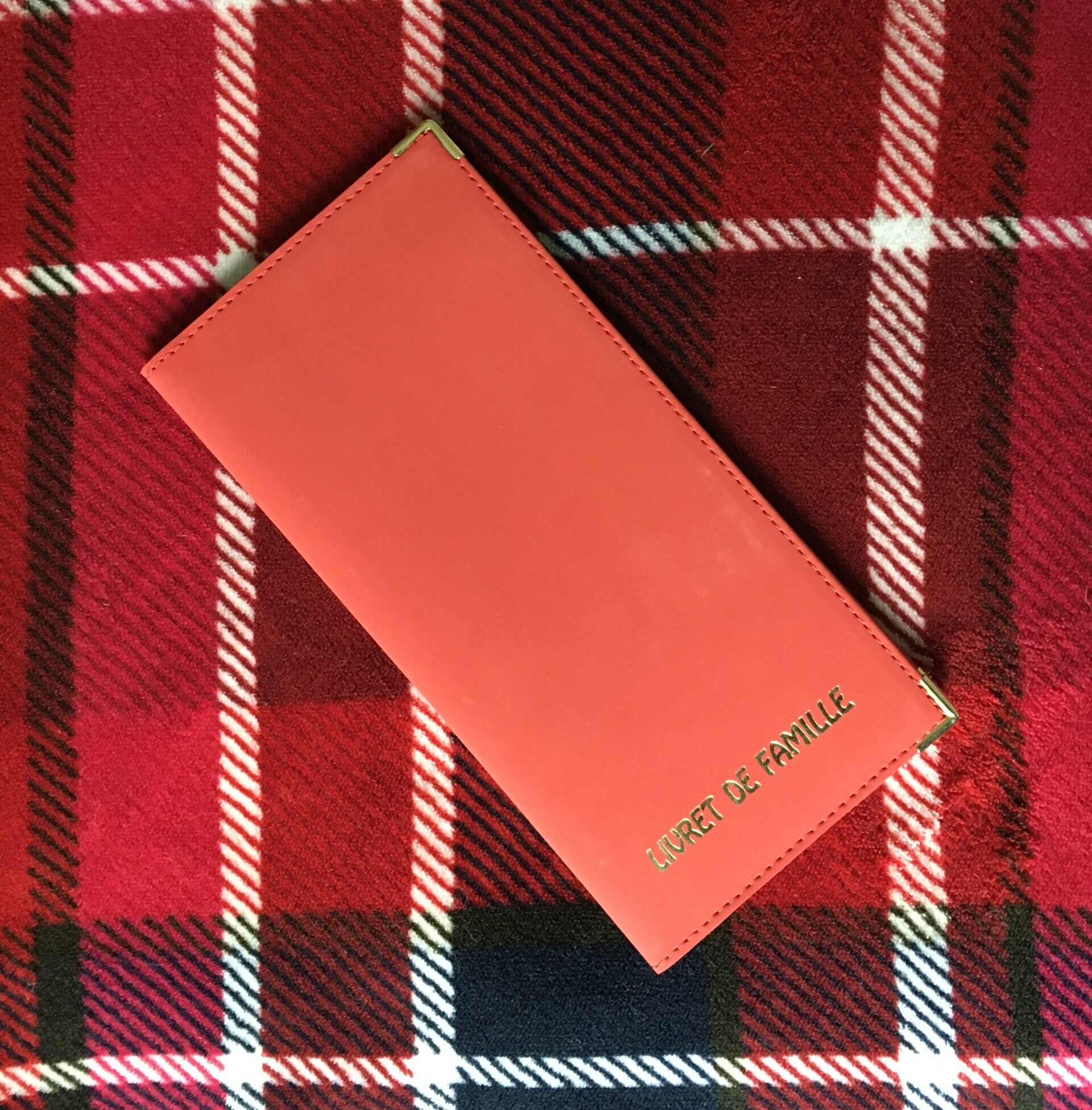
Our Livret de Famille

I hope you have found this information useful or just interesting to read. Let me know if you have any questions!
If you have gotten married in France, let me know how your experience was in the comments below!

Bisous,
Rose

A support unit has been set up at the Directorate-General for Foreign Nationals in France:
phone number: 0806 001 620
e-mail: dgef-support@interieur.gouv.fr


Read More:

  • Getting Married in France (Twice!)
  • I Went to a Traditional French Catholic Wedding!Bride at altar
  • How to Apply for a Visa de Long Séjour- Valant Titre de Séjour vie privée et familiale (VLS-TS) as an American Spouse of a French Citizen While Living in the UKVLS-TS France

Share this:

  • Share on Pinterest (Opens in new window) Pinterest
  • Share on Facebook (Opens in new window) Facebook
  • More
  • Share on Reddit (Opens in new window) Reddit
  • Email a link to a friend (Opens in new window) Email
  • Share on X (Opens in new window) X

Leave a ReplyCancel reply

This site uses Akismet to reduce spam. Learn how your comment data is processed.


Salut! I’m Rose.
I’m an American married to a Frenchman living in the countryside of France. I’m here to fill you in on life here, from administrative paperwork to weird customs to underrated places to visit.

Support This Blog

Imagine my surprise when I walked into the Treasur Imagine my surprise when I walked into the Treasury of the Abbey of Sainte-Foy in Conques to find this stained glass on display. 

I’m a huge nerd for stained glass & these works are particularly interesting.

Swipe for the history of these bays. 👉🏻 

📷 La Translation des Reliques de Sainte Foy. Francis Chigot & Pierre Parot (illustration).
The transfer of the relics of Saint Faith. 

#FrancisChigot #stainedglass #abbatialesaintefoy #Conques #FrenchHistory 

Created by stained-glass artist Francis Chigot of Limoges (1879-1960) for the Monuments Historiques in 1940 (yes, during the war!), these windows once adorned the Abbatiale of Sainte-Foy of Conques. 

Pierre Parot, one of Chigot’s trusted illustrators, designed the 104 windows which would take over a decade to be created.

Of the windows I have seen, colors seem to concentrate around jewel-tones as well as a range of oranges which must have been really complimentary to the architecture of the abbey, especially the orange toned stained glass against the red sandstone and yellowish limestone of its construction. 

If you’ve visited or seen photos of Conques, you are aware that the stained glass adorning its bays is nothing like those created by Chigot. 👉🏻

📷 La Translation des Reliques de Sainte Foy. 
Francis Chigot & Pierre Parot (illustration).
The transfer of the relics of Saint Faith.

#FrancisChigot #stainedglass #abbatialesaintefoy #Conques #FrenchHistory 

Unfortunately, Chigot’s work was deinstalled from 1990 to 1992 as part of a project to replace all windows beginning in 1987.

The colorful glass, many of which was narrative, was replaced in 1994 with (in my opinion) dull and unimaginative stained glass designed by Pierre Soulages, an artist local to the region. 

On the bright side, many of the Chigot windows have been preserved & are now permanently integrated into architecture or are on display in different areas around the region. Not only does this keep them in good condition, we are still able to admire their beauty and details (up close!) nearly 80 years after their creation… such as these little faces painted in a very typical 1940s/50s fashion!

#FrancisChigot #stainedglass #abbatiale
Penne is such a wonderful medieval village without Penne is such a wonderful medieval village without all of the tourists. 
Plus, they have a 12th century fortified castle constructed on a cliffside that they are slowly rebuilding proper medieval style, brick by brick, by hand. 

#Penne #occitanie #medievalarchitecture #France #medievalfrance
Penne (Tarn) is such a wonderful medieval village Penne (Tarn) is such a wonderful medieval village without all of the tourists. 

Plus, they have a 12th century fortified castle constructed on a cliffside that they are slowly rebuilding proper medieval style, brick by brick, by hand. 

#Penne #occitanie #medievalarchitecture #France #medievalfrance
Two views. One beautiful place. Le Pont Vieux, C Two views. One beautiful place. 

Le Pont Vieux, Camarès. 
A beautiful stone bridge dating back to the 11th century crossing over the Dourdou. 
Interestingly, the name “Camarès” once referred to the region, while the town itself was known as Pont-de-Camarès, deriving the name from the Pont Vieux (the old bridge) which was one of the only means of crossing the river.

#Occitanie #France #Camarès #frenchhistory #historicalplaces 

Two views. One beautiful place. 

Le Pont Neuf, Camarès. 
The Pont Neuf (new bridge), built in 1856, was the consequence of an Industrial Revolution taking place in Camarès. As early as the 17th century, textile mills dotted the banks of the Dourdou, first reputed for their woolen blankets, then their knitwear.

What I find most interesting is that this past, although I had no previous knowledge of the town’s history whilst visiting, was so evidently clear in the architecture left behind from the 19th century. 
Plus the views are breathtaking. 

#Occitanie #France #Camarès #frenchhistory #historicalplaces 

Olivet, “Camarès (Aveyron) - Le Pont Vieux et le Quartier de L’Eglise.” No date.

#Occitanie #France #Camarès #frenchhistory #historicalplaces 

Unknown, “Camarès - Le Pont Neuf, 22 August 1929”

#Occitanie #France #Camarès #frenchhistory #historicalplaces
Just a little archway to adventure. #penne #penn Just a little archway to adventure. 

#penne #pennetarn #tarn #france #francetravel
Beautiful frosted glass contrasts with the golden Beautiful frosted glass contrasts with the golden tones of silver stained curves. Stained-glass designed by Fabienne Verdier in 2018.

 #church #architecture #history #frenchblog #travelinfrance #travel #expatinfrance #France #hiddengems #frenchcountrysideguide #frencharchitecture #frenchchurch #eglise #tourisminfrance #stainedglass #frenchstainedglass #vitrail #vitraux #fabienneverdier #champagnetourisme #aube #aubetourisme #routeduvitrail #nogentsurseine #travelblog #expatblog #Francetravel
Constructed on the site of a former salt storehous Constructed on the site of a former salt storehouse in 1670, the greniers à sel (salt storehouses) are a beautiful reminder of Honfleur’s maritime history. 

Originally a trio of stores, only two are extant; the later of the stores, built in 1699, burnt down in 1892.

Designed to store the salt necessary for fishing (herring and cod), they were one of the largest open salt stores in Normandy. It is likely that the stones creating its walls are the remnants of the city’s old fortifications. 

Sold as national property during the French Revolution in 1791, it was not until 1806 that the state transferred ownership of the large salt storehouse (at 500m2) to the town of Honfleur. At this time, it was used as a butcher’s shop and then reinstated as a salt storehouse up until 1908 where it was later sold. The town repurchased the store in 1949.

As for the small salt store (at 381m2), it remained private property until 1952, when it was purchased by the town of Honfleur. 

Both of the storehouses were classified as historic monuments in 1916.

Pictured is the exterior pathway between both of the storehouses that connects them together.

 #MonumentHistorique #architecture #blog #historicalmonument #history #frenchblog #historicalplace #expatlife #travelinfrance #travel #cultureblogger #americaninfrance #lifeinfrance #frenchcountrysideguide #frenchpatrimony #frenchhistory #france #Frencharchitecture #Francetravel #travelblog #Honfleur #Normandy #Normandie #greniersàsel #greniersàseldhonfleur #stonework #masonry  #expatinfrance  #expatblog #travelblog
Stained glass designed by Maurice Rocher (dating t Stained glass designed by Maurice Rocher (dating to 1973) located in the Chapelle de l'Immaculée at the Basilique Sainte-Anne d'Auray in Morbihan, Bretagne.

#bretagne #brittanyfrance #breizh #brittany #BZH #Morbihan #baiedequiberon #sainteannedauray #auray #travelblog #vitraux #stainedglass #Francetravel #expatblog #France #Frencharchitecture #frenchcountrysideguide #frenchpatrimony #travel #travelinFrance #cultureblogger #historicalplace #architecture #monumenthistorique #historicalmonument #church
More, just because. #bastilleday #14juillet #pris More, just because.

#bastilleday #14juillet #prisedelabastille1789 #prisedelabastille #fireworks #feudartifice #frenchcountrysideguide #blog #americanexpat #history #frenchblog #expatlife #frenchcountryliving #travel #expatinfrance #cultureblogger #liveinfrance #americaninfrance #lifeinfrance #frenchhistory #france #frenchvillage #expatblog #travelblog
Follow for Updates

Recent Posts

  • Renewing an Adult 10-Year U.S. Passport in France by Mail
  • I Went to a Traditional French Catholic Wedding!
  • The OFII In France and the Integration Process: La Formation Civique
  • Sens & Villenueve-sur-Yonne, A Day Out Exploring in Bourgogne
  • “Chandeleur,” The Day of Crêpes… and Candles?

Archives

  • June 2025
  • August 2023
  • July 2023
  • March 2023
  • February 2023
  • January 2023
  • January 2022
  • August 2021
  • June 2021
  • May 2021
  • April 2021
  • March 2021
  • December 2020
  • November 2020
  • October 2020
Banner supporting blood donation

Legal

  • About
  • Contact
  • Cookie Policy
  • Intellectual Property
  • Privacy Policy

Search

© 2026 The French Countryside Guide | Powered by Minimalist Blog WordPress Theme